
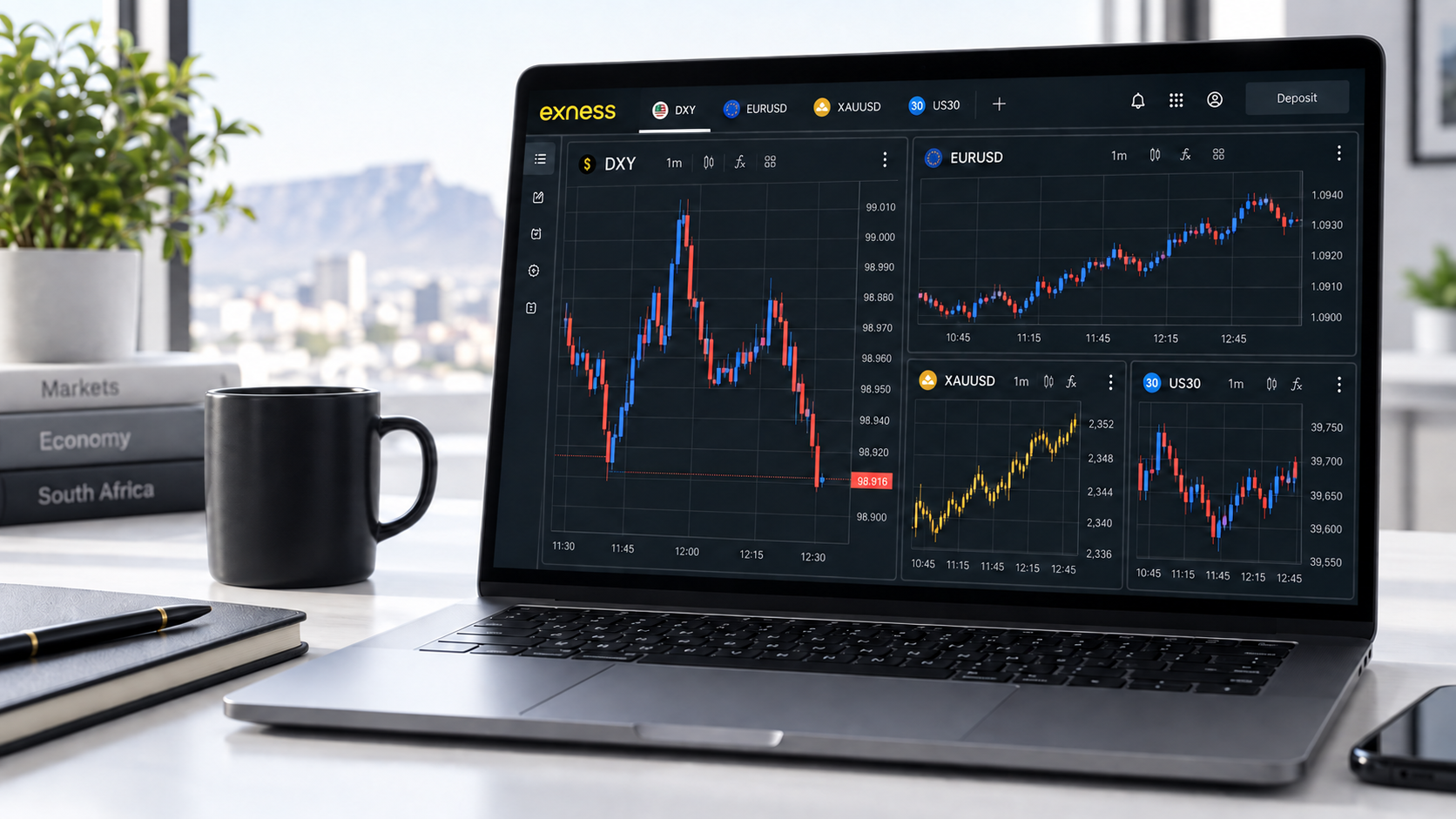
The US dollar influences currencies, commodities and equities at the same time. A change in US interest-rate expectations can move the Dollar Index, affect major forex pairs, change the price of gold and alter sentiment towards US shares.
This makes DXY useful beyond trading the index itself. At Exness, traders can monitor DXY alongside forex, gold and US30 in the same terminal, using the four markets to build a broader view of dollar strength, interest-rate expectations and risk sentiment.
These instruments are connected, but they are not interchangeable. Each measures a different part of the market, and every position carries its own trading costs and risk.
Four markets, four different signals
DXY measures the performance of the US dollar against a basket of six currencies. Forex pairs compare the dollar directly with one other currency. Gold is a globally traded asset priced in US dollars, while US30 tracks 30 large US companies.
The table summarises the main differences.
| Instrument | What it represents | Typical relationship with DXY | Exness trading-cost fact |
| DXY | The US dollar against EUR, JPY, GBP, CAD, SEK and CHF | Direct measure of broad dollar strength | Exness Pro Account recorded average DXY spreads 83% below the industry average during the comparison period.¹ |
| EURUSD | The euro against the US dollar | Frequently moves inversely to DXY because the euro has the largest weight in the index | A separate floating forex spread applies when a position is opened. |
| Gold | The international gold price quoted in US dollars | Often moves in the opposite direction to DXY, although the relationship can break | A gold position has its own spread, independent of any open DXY position. |
| US30 | A CFD linked to 30 major US-listed companies | The relationship is indirect and can change with rates, earnings and market sentiment | A US30 position has its own index spread and trading conditions. |
The key cost point is straightforward: watching four instruments in one terminal does not combine their costs. Opening positions in DXY, forex, gold and US30 means paying the applicable spread on each position.
Current indicative pricing and the available account settings can be checked on the Exness DXY page and inside the trading platform.²
DXY and forex can reveal duplicated dollar exposure
DXY is not an equally weighted measure of every major currency. According to the ICE methodology for the US Dollar Index, it is calculated from six currencies, with the euro carrying by far the largest weight.
This is why DXY and EURUSD frequently move in opposite directions. A rising EURUSD normally indicates that the euro is gaining against the dollar, while a rising DXY indicates broader dollar strength.
The relationship can be useful for confirmation. If DXY breaks above resistance while EURUSD breaks below support, both charts may be reflecting the same underlying dollar move.
It also creates a position-management issue. Buying DXY and selling EURUSD does not necessarily diversify a portfolio. Both positions can express a similar view: that the dollar will strengthen. The trader may therefore be increasing the same directional exposure through two different instruments.
Other forex pairs need to be read according to where USD appears:
| Forex pair | If the dollar strengthens, all else equal |
| EURUSD | The pair may fall |
| GBPUSD | The pair may fall |
| USDJPY | The pair may rise |
| USDCHF | The pair may rise |
| USDCAD | The pair may rise |
“All else equal” matters. A currency pair can move because of developments on either side. USDJPY, for example, may react to both Federal Reserve expectations and policy signals from the Bank of Japan.
The Federal Reserve explains that changes in US interest rates affect the relative attractiveness of US assets and can therefore influence exchange rates. However, the Fed does not target a specific value for the dollar. Its monetary-policy decisions affect several markets through interest rates, asset prices and broader financial conditions.
DXY and gold do not always move in opposite directions
Gold is priced internationally in US dollars. When the dollar strengthens, gold becomes more expensive in other currencies, which can reduce demand and place pressure on the dollar-denominated gold price.
That helps explain why DXY and gold have often shown an inverse relationship. The World Gold Council describes gold as a natural hedge to the dollar and notes that the currency has a significant influence on its price.
The relationship is not fixed. Gold also reacts to:
- Real interest rates
- Inflation expectations
- Central-bank demand
- Geopolitical risk
- Investment flows
- Changes in market liquidity
During a sharp risk-off event, both DXY and gold can rise as investors seek assets perceived as defensive. A trader relying only on the usual inverse relationship could therefore misread the move.
A more practical approach is to use DXY for context and analyse the gold chart independently. If both instruments confirm the expected relationship, the signal may be clearer. If they diverge, the divergence itself can indicate that another driver is dominating the market.
DXY and US30 reflect different parts of the US economy
US30 is the name used at Exness for the instrument linked to the Dow Jones Industrial Average. It represents a group of major US companies rather than the dollar itself.
A stronger dollar can create a headwind for multinational companies because revenue earned abroad converts into fewer dollars. At the same time, dollar strength may reflect a relatively strong US economy or demand for US assets, which can support equities.
Interest-rate expectations introduce another variable. Higher expected rates may support the dollar but place pressure on shares through higher borrowing costs and lower equity valuations. Softer rate expectations may weaken DXY while supporting US30.
As a result, DXY and US30 can move:
- In opposite directions when rates or currency translation dominate
- In the same direction when confidence in the US economy dominates
- Independently when company earnings or equity-specific news takes control
This makes US30 a context market for DXY rather than a mechanical confirmation signal. Exness lists US30 together with US500 and USTEC within its range of index CFDs.
One platform does not mean one combined trade
The practical benefit of monitoring these markets together is comparison. A trader can keep DXY, a selected forex pair, gold and US30 on the same watchlist and examine how each responds to the same event.
At Exness, they remain separate CFD instruments:
- DXY expresses a view on broad US dollar performance.
- A forex pair isolates the dollar against one currency.
- Gold adds information about real rates, inflation and defensive demand.
- US30 reflects large-company performance and equity sentiment.
Opening several positions can increase exposure rather than reduce it. A long DXY position, short EURUSD position and short gold position may all benefit from the same dollar-strength scenario. If the dollar reverses, all three can move against the trader together.
Position size should therefore be considered across the whole portfolio, not instrument by instrument.
Trading costs must also be assessed across the portfolio
The spread is the gap between the bid and ask price. It creates an initial cost when a position is opened and becomes particularly relevant for short-duration strategies, larger position sizes and trading around economic releases.
If a trader opens DXY together with EURUSD, gold and US30, there are four separate spreads. Depending on the account and holding period, commission and overnight swap may also apply.
The Exness trading calculator can be used to estimate margin, spread cost, commission and swap before placing a trade. These figures should be calculated for every proposed position and then reviewed as a combined portfolio cost.
Margin is not itself a trading fee, but it determines how much capital is allocated to maintain the position. Leverage can increase market exposure relative to the capital committed, magnifying both gains and losses.
A practical multi-market workflow
A structured process can keep the analysis focused:
- Check DXY to establish the broad dollar direction.
- Compare EURUSD or another relevant forex pair with the DXY move.
- Check whether gold confirms or contradicts the dollar view.
- Use US30 to assess how equity traders are reacting to the same macro conditions.
- Review the spread and other costs for every instrument being considered.
- Calculate the total portfolio exposure before opening more than one position.
The Exness Terminal allows these instruments to be monitored from a single platform. Traders can also test the workflow on a demo account before using real funds.
For additional South African context on managing currency exposure, Business Link has previously examined how companies approach foreign-exchange risk and hedging.
The main takeaway
DXY can act as the starting point for analysing forex, gold and US30, but it should not be treated as a guaranteed signal for any of them.
At Exness, traders can access all four markets from the same trading environment. This makes comparison easier, while the positions, spreads and risks remain separate.
The most useful role for DXY is therefore not to predict every other chart. It is to provide a clear benchmark for dollar strength that can be tested against the price action in currencies, gold and US equities.
For more articles like this click here.
If you enjoyed this website then check out our other sites: Wedding and Function, Home Food and Travel, Kids Connection, Thirsty Traveler, Bargain Buys, Boat Trips for Africa.
Need help with your online marketing then visit Agency One