

Edited extract from Momentum Group’s 18 November 2026 CPI note, by economists Sanisha Packirisamy and Tshiamo Masike.
South Africa’s headline inflation rate accelerated to 5.2% year on year in October from 4.5% in September. Momentum Group’s November CPI note examines the pressure from fuel prices, the household cost outlook and the case for a cautious approach to interest rates.
Update, 19 November 2026: The South African Reserve Bank subsequently kept the policy rate unchanged at 7.25%. Four committee members preferred no change and three favoured an increase of 25 basis points. Read the SARB statement https://resbank.co.za/en/home/publications/publication-detail-pages/statements/monetary-policy-statements/2026/november.
Fuel drives the inflation increase
The acceleration was largely driven by a sharp increase in domestic fuel prices, which pushed transport inflation higher. Transport was a major contributor to the rise in headline inflation, with the category recording an inflation rate of 15.2% year on year, compared with 10.8% in September.
Core inflation, which excludes food, non-alcoholic beverages, fuel and energy, ticked up to 4.2% year on year in October, from 4% in September.
Goods inflation rose to 5.3% in October from 4.1% in September, while services inflation edged higher to 5% from 4.9%. The official October figures are available from Statistics South Africa https://www.statssa.gov.za/publications/P0141/P0141October2026.pdf.
Momentum’s note argues that the rise across goods and services, alongside the increase in core inflation, suggests price pressures may be starting to broaden beyond the direct impact of higher fuel costs. Its assessment was that the relatively modest increase in services inflation indicated second-round effects remained contained at that point.
Crude oil relief does not remove diesel risks
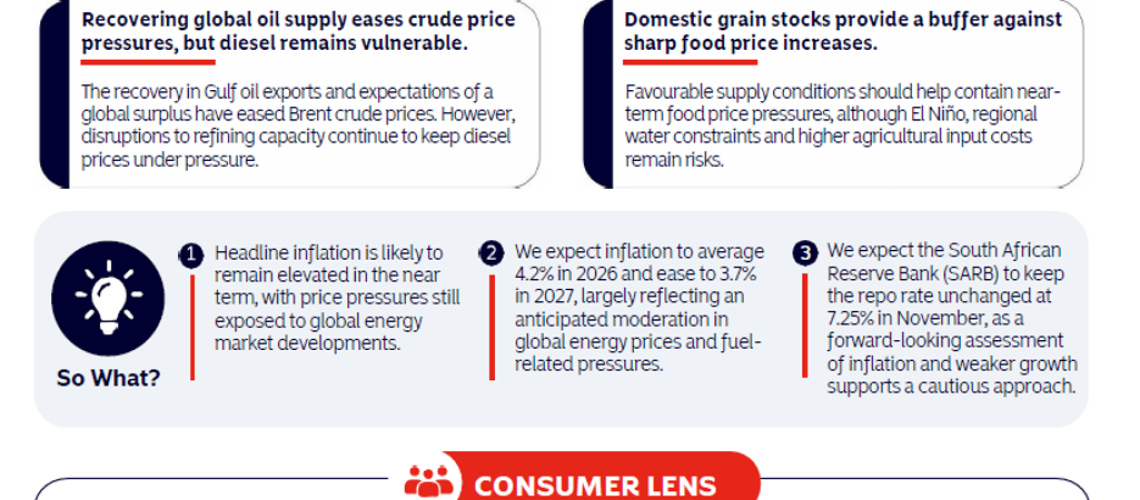
The note identifies an important distinction in the energy outlook: an improvement in crude oil supply does not automatically translate into a similar recovery in the availability of refined fuels, particularly diesel.
Momentum’s economists cite disruptions to refined-product exports and refinery operations as reasons for continued pressure on diesel markets. Their mid-November assessment also noted that a weaker rand could offset some benefit from lower international petroleum prices.
At the time of the note, mid-month Central Energy Fund data pointed to potential December reductions of approximately R3.50 per litre for petrol and R1.35 per litre for diesel. These were preliminary estimates, before the scaling back of temporary fuel-levy relief and other adjustments. They are not confirmed December pump prices.
Food supply offers a buffer
The economists point to domestic grain stocks and softer international cereal prices as buffers against sharper food price increases. They nevertheless identify El Niño, regional water constraints and higher agricultural input costs as risks.
Their analysis distinguishes the relatively comfortable domestic grain-supply position from the pressures that weather, water availability and input costs could create for the coming production season.
The forecasts in context
Before the November interest-rate announcement, Momentum expected inflation to average 4.2% in 2026 and ease to 3.7% in 2027, largely reflecting an anticipated moderation in global energy prices and fuel-related pressures.
The economists expected the SARB to keep the repo rate at 7.25%, arguing that the forward-looking nature of monetary policy and weaker domestic growth supported caution. The rate was subsequently held on 19 November.
The note said policymakers would continue to assess the persistence of higher fuel prices, pass-through to other goods and services, food-price pressures and any upward adjustment in inflation expectations.
Infographic supplied by Momentum Group. Prepared before the SARB’s 19 November decision.